Value-based pricing: You always get more time back than what you pay for. 30-day money-back guarantee
Services Results About Case Studies Workflow Automation Financial Advisors Book a free call ↗
Case Study Healthcare AI Email Triage

50 SMS replies a day.
Zero reception time.

SportsFit Health and Rehab runs two Sydney clinics with 15 practitioners. Every day, around 50 Cliniko SMS reminder replies landed in the admin inbox - confirmations, reschedules, and the occasional unrelated message. We built a Make.com automation that uses Claude to read each reply, route reschedules to the right physio, and silently delete the rest.

Client

SportsFit Health and Rehab

Industry

Sports Physiotherapy

Tools Used

Make.com Anthropic Claude Gmail Google Sheets

1-2 hrs

Reception time saved
every single day

~2 sec

Per-email processing
and routing time

~$0.002

Cost per email
in AI API spend

The Problem

Reception was spending mornings
sorting "Y" replies by hand.

Every day at 1pm, Cliniko sent SMS appointment reminders to patients across the Five Dock and Gladesville clinics. Every reply came back as an email to a shared admin inbox - around 50 replies per day, across 15 practitioners in physio, chiro, exercise physiology, and massage therapy.

Reception had to read each one, figure out which practitioner it belonged to, and forward reschedule requests by hand. Confirmations - the vast majority - were just a "Y" that still had to be opened, read, and deleted.

The work was repetitive, error-prone, and pulled reception away from patients at the desk - while physios weren't seeing reschedule requests in real time, leading to gaps in the schedule. All up: 1 to 2 hours of admin time, every single day.

The Solution

AI reads every reply. The inbox
handles itself.

We built a Make.com automation that triages every SMS reply the moment it arrives. Anthropic's Claude reads each email, classifies the intent, and matches it to the right practitioner.

Confirmations are deleted silently. Reschedules are forwarded directly to the relevant physio within seconds. Anything ambiguous is flagged for a human - so nothing important slips through.

What happens automatically

1

SMS reply lands in the admin inbox

2

Claude classifies intent and practitioner

3

Router sends it down the right path

4

Reschedule forwarded to that practitioner

Confirmations auto-deleted, edge cases flagged

How It Works

Four steps. One AI call. Zero touches.

1

Gmail auto-forwards each Cliniko reply to Make.com

The moment a patient replies to an SMS reminder, the email is forwarded to a Make.com mailhook - no polling, no delay.

2

Claude classifies the email with structured tool use

A forced tool call returns deterministic JSON: the message category (Confirm, Reschedule, or Other), the practitioner matched against the clinic's roster, and the patient name.

3

A four-way router sends the email down the correct path

Confirm - auto-deleted, no human touches it. Reschedule + known practitioner - their email is looked up in a Google Sheet, the message is forwarded with a branded signature, then deleted from the admin inbox. Reschedule but practitioner unclear, or Other - labelled "Needs Review" for human triage.

4

A deduplication check stops Gmail double-forwards

A Make.com data store keyed on the Gmail Message ID prevents the same reply being processed twice when Gmail occasionally double-forwards.

Key Design Decisions

Why this automation can be trusted.

Structured AI output, not text parsing

Claude returns structured JSON via a forced tool call rather than free text. That gives deterministic field mapping and eliminates the brittle string parsing that breaks the moment an LLM rewords its answer.

"UNKNOWN" fallback over guessing

When a practitioner name is ambiguous - two practitioners sharing a surname, for example - Claude is instructed to return UNKNOWN rather than pick one. Those cases route to human review rather than risk a misrouted email.

Clinic-owned routing table

Practitioner email addresses live in a Google Sheet that the clinic manages themselves. Staff changes - new hires, departures, name changes - don't require any developer involvement.

Human-in-the-loop for ambiguity

Anything the model isn't confident about gets a "Needs Review" label rather than silent deletion or a guess. The automation handles the obvious 95% - reception still owns the edge cases.

Under the Hood

The Make.com automation in action

Mailhook trigger feeds straight into Claude, which classifies the reply. A central router then fans out into four branches - Confirm (delete), Reschedule (lookup, forward, delete), and two "Needs Review" paths for human triage.
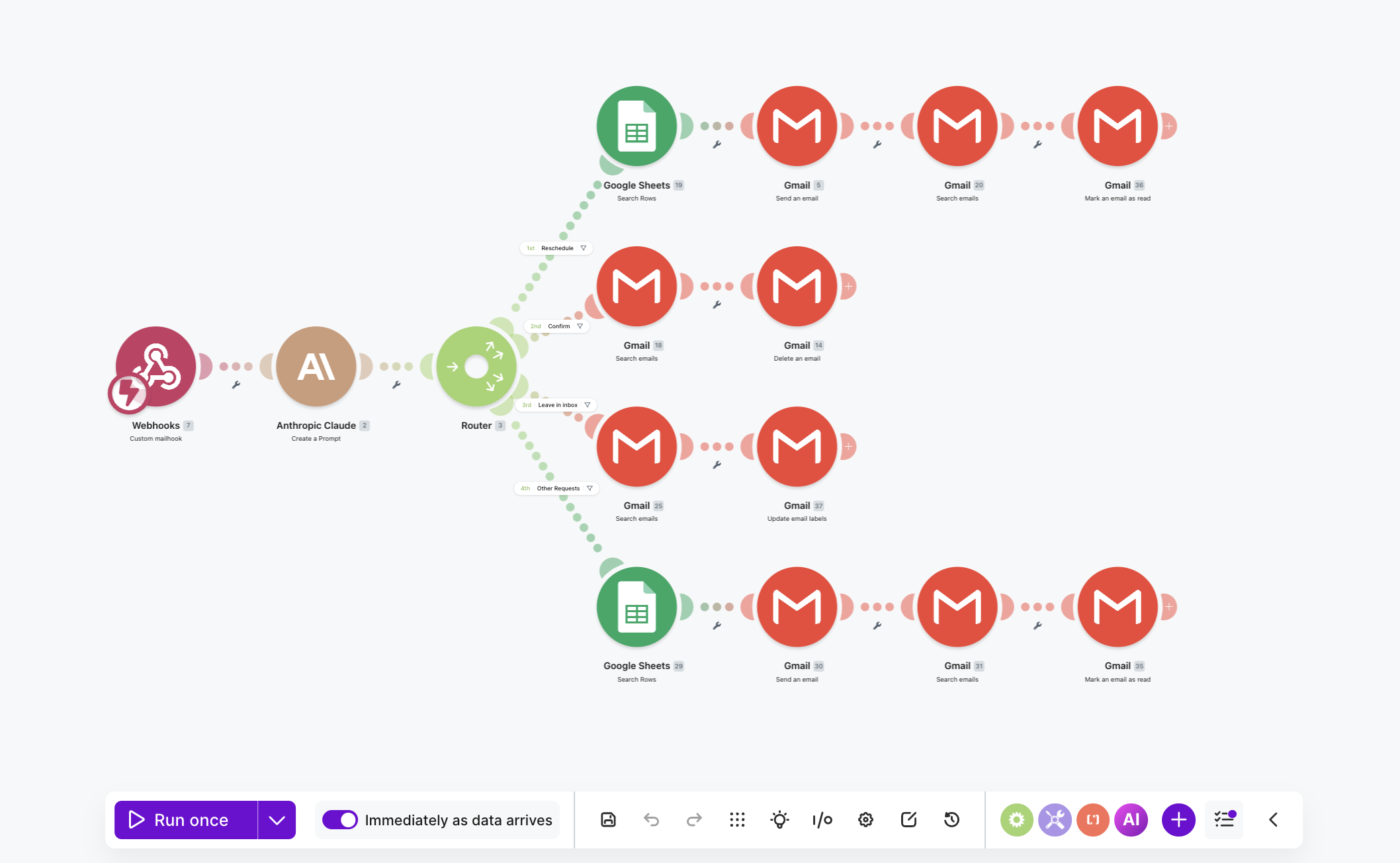
Make.com automation workflow for SportsFit Health and Rehab showing Gmail mailhook, Anthropic Claude classifier, four-way router, and Google Sheets practitioner lookup with Gmail forward and delete branches

Make.com scenario - mailhook to Claude to four-way router, with practitioner lookup and Gmail forward/delete branches

The Results

Before and after.

Before

~50 SMS replies manually triaged daily

reception reading every "Y" by hand

1 to 2 hours of admin time per day

pulling reception away from patients at the desk

Reschedules forwarded manually

delays meant physios saw requests hours late

Risk of misrouted replies

things slipped through a shared inbox

After

Fully automated triage on every reply

no human touches the obvious 95%

Near-zero reception time

only ambiguous edge cases need review

Reschedules in seconds, not hours

forwarded direct to the right practitioner

Deterministic routing with human fallback

UNKNOWN cases escalate, never get guessed

The Numbers

What the automation actually costs.

1-2 hrs

Reception time saved per day

~2 sec

Per email - trigger to routing

$2-$6

AI API cost per month (AUD)

~$0.002

Cost per email triaged

The Impact

Reception is back at the desk.
The inbox runs itself.

Reception staff at both locations no longer spend their mornings working through an inbox full of SMS replies. Confirmations disappear automatically, reschedules reach the right practitioner within seconds, and anything that genuinely needs a human gets flagged - rather than slipping through or sitting in a shared inbox waiting to be noticed. For around the cost of a cup of coffee in API calls per month, the clinic recovered an admin role's worth of weekly time.