Value-based pricing: You always get more time back than what you pay for. 30-day money-back guarantee
Services Results About Case Studies Workflow Automation Financial Advisors Book a free call ↗
Case Study Healthcare AI Content Generation

Five clinic websites.
One weekly input.

SportsFit Health and Rehab runs five clinic websites that all need a steady stream of SEO content to compete in local search. Writing blogs in-house was pulling practitioners and admin away from patient care. We built a weekly automated pipeline powered by Anthropic Claude - the team submits topics, and on-brand drafts land in Google Docs ready for review every week.

Client

SportsFit Health and Rehab

Industry

Sports Physiotherapy

Tools Used

Make.com Anthropic Claude Google Sheets Google Docs

5 sites

Clinic websites supplied
with weekly drafts

Weekly

On-brand SEO drafts
generated automatically

1 input

A topic list from the
team is all that's needed

The Problem

Five websites. Manual blog writing.
An unsustainable content pipeline.

SportsFit Physio operates five clinic websites, each needing a steady stream of SEO content to stay competitive in local search across their Sydney service areas.

The team was writing blogs manually in-house - researching topics, drafting articles, and formatting content across five different sites. It was time-consuming work that pulled practitioners and staff away from their core focus.

The volume required to keep all five websites consistently publishing made the manual approach unsustainable - output was inconsistent, publishing frequency slipped, and the cost in staff hours kept climbing.

The Solution

Topics in. On-brand blogs out.
Every week, automatically.

We built a weekly automated blog generation system powered by Anthropic Claude, trained on SportsFit's clinic guidelines, brand voice, and content standards.

The team simply provides the topics they want covered each week. Claude handles the research and drafting, and fully formatted blog posts arrive in Google Docs - on-brand, structured for SEO, and ready for review before publishing across all five websites.

What happens automatically

1

Team drops topics into a Google Sheet

2

Make.com triggers on schedule each week

3

Claude drafts each blog in SportsFit's voice

4

Drafts land in Google Docs, organised by site

Team reviews and publishes - no writing from scratch

How It Works

Four steps. One topic list. A full week of content.

1

The team submits topics to a Google Sheet

Each row captures a blog idea - topic, target site, and any specific angle - so the team controls editorial direction without touching the automation.

2

Make.com runs on a weekly schedule

The scenario picks up new topics, aggregates them, and prepares each one to be passed through to Claude alongside SportsFit's brand voice and content guidelines.

3

Claude drafts a full SEO blog per topic

Anthropic Claude generates a complete blog post for each topic - written in SportsFit's voice, structured for search performance, and respecting the clinic's content standards.

4

Drafts are delivered to Google Docs, ready to publish

Each completed draft is created as a Google Doc, organised so the team knows which website it belongs to. All that's left is a final review and publish across the five sites.

Key Design Decisions

Why the drafts read like SportsFit wrote them.

Trained on the clinic's own guidelines

Claude is prompted with SportsFit's brand voice document, editorial standards, and clinical tone preferences. The output reads like an in-house piece, not generic AI content.

Team controls the editorial agenda

Topics come from practitioners and admin - the people who actually know what patients are asking about. AI handles the drafting, not the strategy.

Built for SEO structure, not just prose

Each draft follows a structure designed for local search performance - clear headings, intent-matched intro, and natural keyword placement, so the team isn't reformatting after the fact.

Human review before anything goes live

Drafts land in Google Docs, not directly on the websites. The team reads, edits, and publishes - so every piece still gets a clinical eye before it represents the brand.

Under the Hood

The Make.com scenario in action

A Google Sheets trigger feeds the week's topics into the scenario. Each topic is aggregated, enriched, and passed to Claude with SportsFit's voice and SEO brief. The completed draft is then created as a Google Doc and the topic row updated so nothing is generated twice.
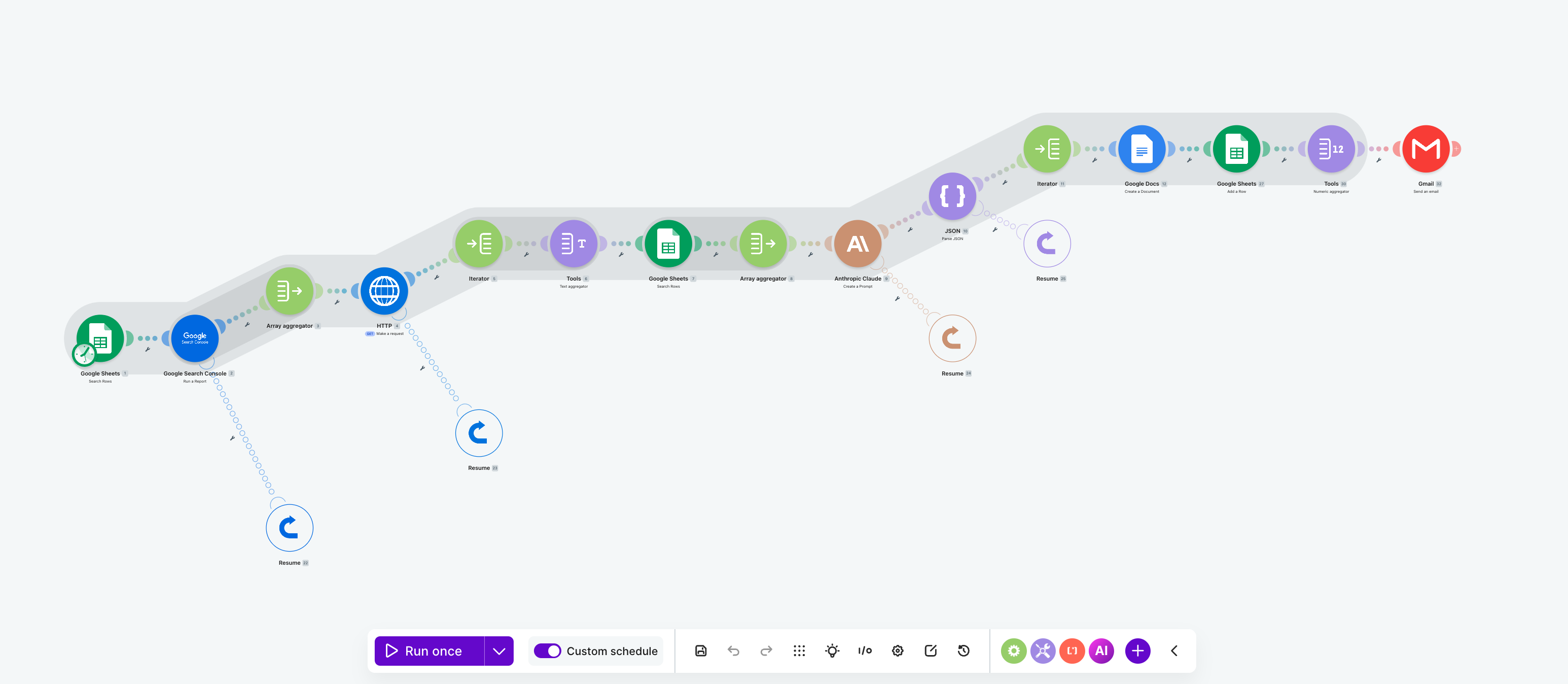
Make.com automation workflow for SportsFit Physio SEO blog generation showing Google Sheets trigger, topic aggregation, Anthropic Claude content generation, and Google Docs delivery

Make.com scenario - Google Sheets topic intake to Claude content generation to Google Docs delivery

The Results

Before and after.

Before

Blog content written manually in-house

research, drafting, formatting - all by hand

Time-consuming work across five sites

staff time spent writing instead of treating

Inconsistent output and frequency

publishing slipped when the team got busy

Unsustainable content volume

five sites is too much for a manual workflow

After

Drafts generated automatically every week

no one writes from scratch any more

Team provides topics - AI handles the rest

staff time refocused on review and publishing

Consistent weekly drafts, on-brand every time

trained on SportsFit's own voice guidelines

A repeatable pipeline across all five sites

scales with the business without scaling headcount

The Numbers

What the pipeline delivers.

5

Clinic websites supplied with content

Weekly

Cadence of on-brand drafts delivered

1 input

A topic list is all the team has to provide

0

Blogs written from scratch by staff

The Impact

A reliable content engine,
without the writing burden.

SportsFit now has a repeatable content pipeline producing on-brand SEO blog drafts across all five websites every single week - without anyone on the team writing from scratch. Because the system is trained on the clinic's own guidelines and voice, the output reads like their team wrote it. Staff review and publish - the heavy lifting is done automatically, and the websites stay consistently fed with the kind of content that earns local search rankings.